Alfalfa (Medicago sativa), also known as Lucerne, Purple Medick and Trefoil, is a cool season, flowering, perennial, legume. Alfalfa grows to a height of about three feet and can live from five to twelve years. It is an important forage crop that grows throughout the world in an assortment of climates. Alfalfa originated in Asia and was first cultivated by the Arabs in Iran, before 700 BC. Related species are grow wild all over central Asia and into Siberia. In 490 B.C. Roman writers give accounts of using Alfalfa as feed for their animals. Alfalfa was brought to California during the Gold Rush, from South America.
Alfalfa can be used as pasture, alfalfa hay, or cut and dehydrated to make protein rich meal. It is highly valued as feed for cows, horses, sheep, goats, pigs, camels and llamas. It is the oldest forage crop in the U.S.
Normally alfalfa flowers are purple to blue-violet, some have shades of white and yellow. Each flower grows on its own stalk from a common stem with 10 to 50 individual flowers. The flowers bloom from July to September. Alfalfa hay can be sown in spring or fall, it likes a well-drained soil with potash as a fertilizer.
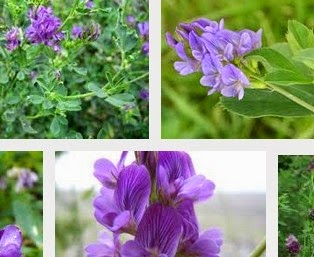
Alfalfa (Medicago sativa)